Introduction
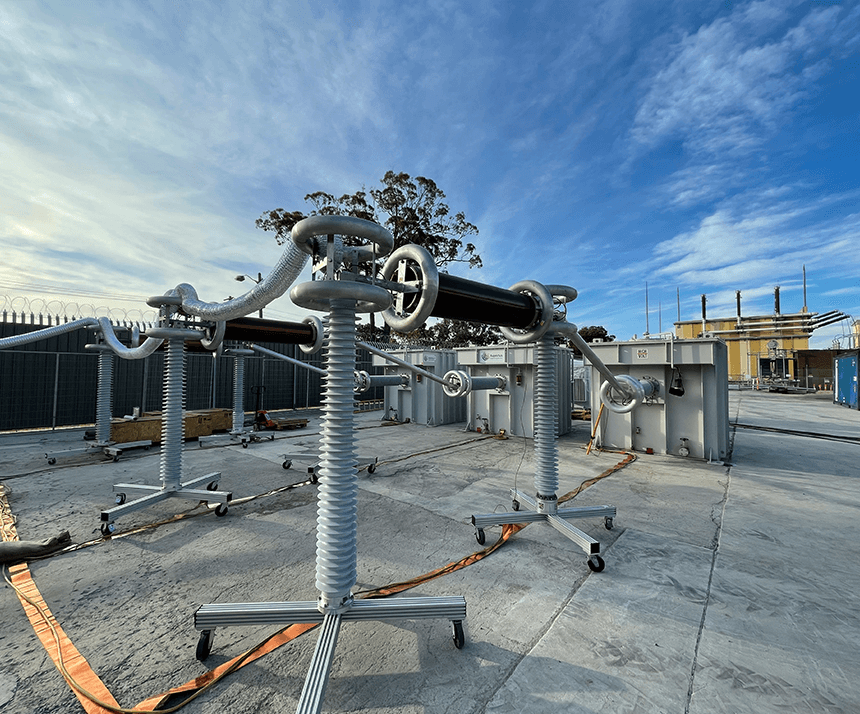
We provide specialised on-site HVAC testing services for critical high-voltage infrastructure.
We perform on-site High Voltage Resonant Test for
- HVAC cables up to 520kV
- Power Transformers up to 560kV
- Gas Insulated Switchgears up to 680kV
Our experienced specialists have successfully completed more than 190 on-site high-voltage resonant tests.
Our specialists and test systems have supported high-voltage projects across multiple regions and operating environments worldwide.
HVAC Cable Systems
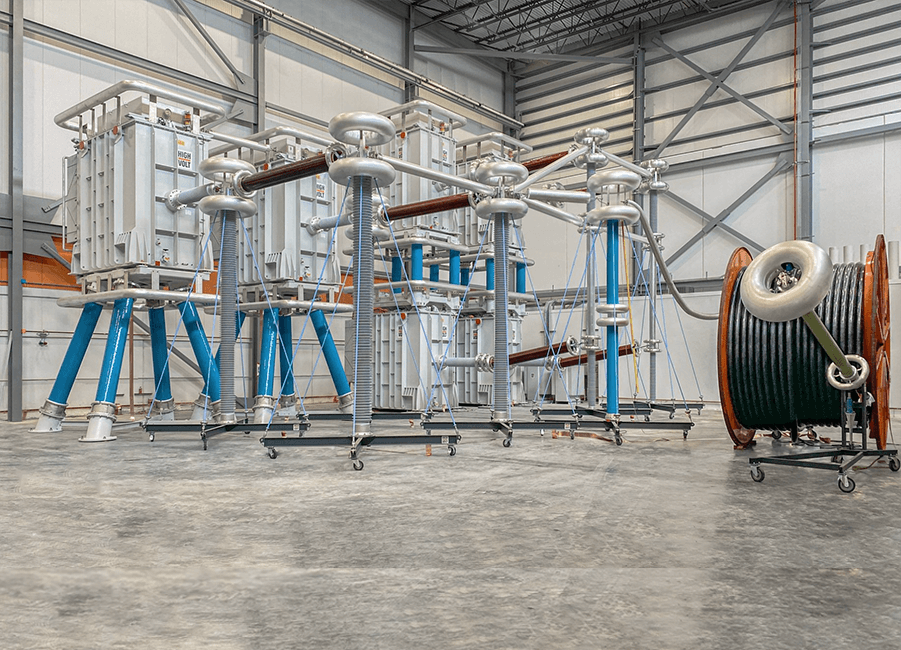
IEC60840 and IEC62067 recommend a near power frequency test (20Hz to 300Hz) at a voltage of 1.7 or 2.0 U0 for 60 minutes. This would require a test voltage of 226kV for a cable with 230kV nominal voltage.
Why Perform an On-Site HVAC Test?
- Ensure correct installation: CIGRE Brochure B1-210 concluded that in 8.3% of all tests a fault is identified!
- Realistic Test: Only a near power frequency test triggers partial discharge with a sufficient high probability.
- Ensure Asset Performance: 1.7 U0 equals the allowable overstress of the cable in service.
- Identify Latent Defects: Even if no breakdown occurs, partial discharge measurement can reveal defects such as voids or other imperfections.
- Avoid Consequential Damage: In case of a fault during test, the limited test power avoids collateral damage.
We use exclusively German quality testing technology from HIGHVOLT.
Our modular tank reactor systems provide substantial test capacity for long EHV cable circuits, depending on cable capacitance, required test voltage and project configuration.
Transformers and GIS
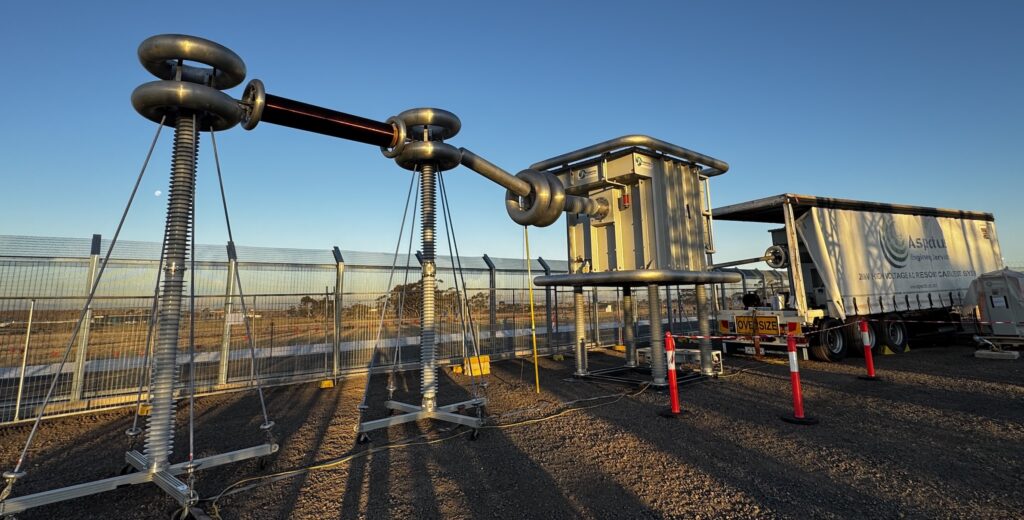
Our modular systems provide time- and cost-efficient testing solutions for smaller capacitances, such as transformers and gas-insulated switchgear (GIS). While site testing of GIS and cables after installation is mandatory, as these are partially manufactured on site, applied voltage testing for transformers is not yet a standard requirement.
However, we are observing growing interest in performing high-voltage on-site commissioning tests for transformers to ensure the quality of the asset and workmanship during installation, as well as to rule out any transport damage.
Typical Testing Parameters:
- Transformers: Apply the test voltage according to the insulation levels stated on the transformer nameplate for one minute, subject to the applicable requirements of IEC 60076-3.
- GIS: Test voltages depend on the application and applicable requirements, typically ranging from 2 to 3 U0 for one minute.
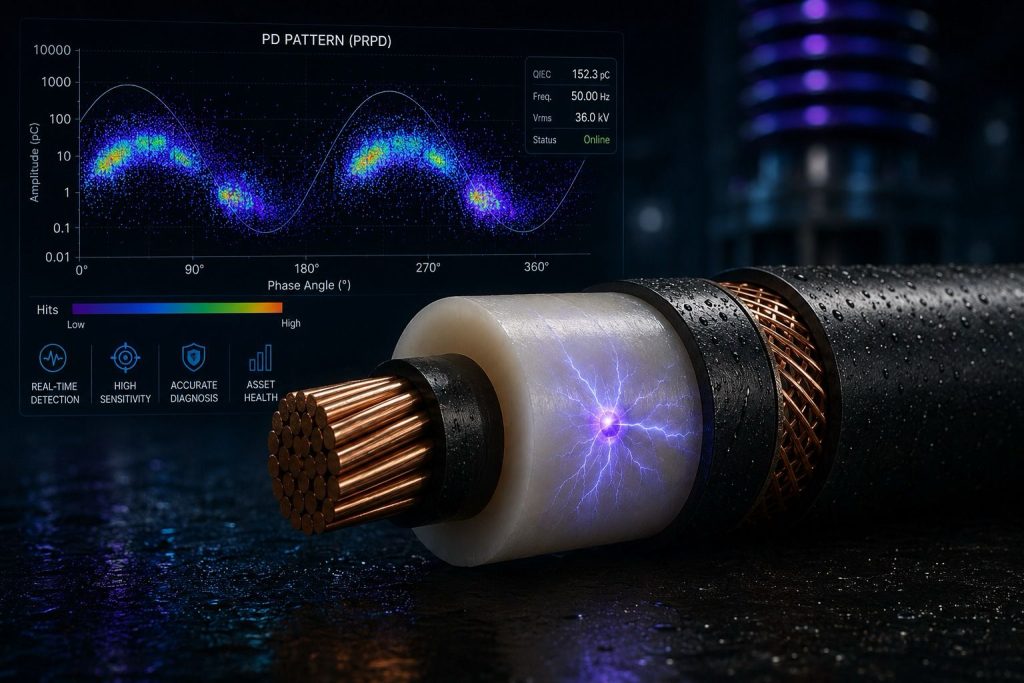
Partial Discharge Measurement
Partial discharge (PD) measurement is a valuable diagnostic technique used to detect localised electrical discharges within insulation systems that may develop into insulation failure if left undetected. It provides important insight into the condition of cables, transformers, gas-insulated switchgear and other high-voltage assets during commissioning, maintenance and diagnostic investigations.
PD measurements are typically performed at a reduced voltage level compared with the preceding withstand test. The acceptance criterion for HV applications is generally the absence of detectable partial discharge at the specified measurement voltage.
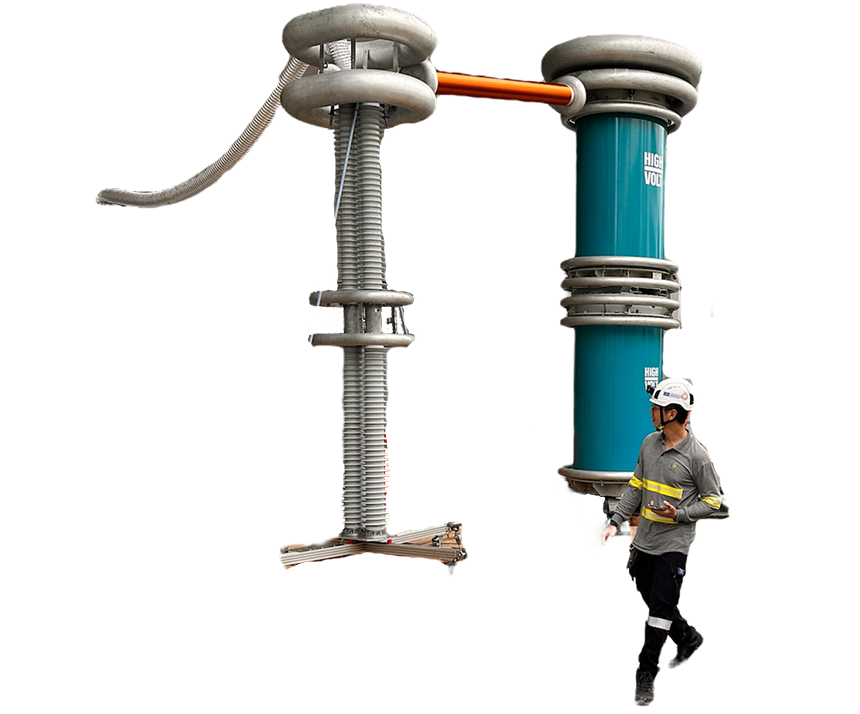
We provide PD measurement services using coupling capacitors, high-frequency current transformers (HFCTs) and ultrasonic detection technologies, supported by expert interpretation and analysis as part of selected high-voltage testing programmes.
Stationary Testing Capacity in Singapore and Australia
Our experts and test equipment support high-voltage testing projects across a broad region, spanning the Middle East, Southeast Asia, Australia and Oceania. Singapore, Malaysia, Vietnam and Australia are core markets.
While Singapore remains our main operating base, substantial testing equipment is also permanently stationed in Australia. This investment demonstrates our commitment to the Australian market and allows us to provide local testing capacity, reduced mobilisation