
Test with the Best!
We provide specialised high-voltage testing solutions for critical transmission and distribution infrastructure across South East Asia and Oceania.
We perform On-Site High Voltage Tests for:
- HVAC cables up to 520kV
- HVDC cables up to 800kV
- Power Transformers up to 560kV
- Gas Insulated Switchgears up to 680kV
Our experienced specialists have successfully completed more than 190 on-site high-voltage resonant tests. Our specialists and test systems have supported high-voltage projects across multiple regions and operating environments worldwide.
Successful HV testing begins long before the test equipment arrives on site. Cable parameters, system configuration, connection arrangements, temporary power requirements, site constraints and test methodology selection all influence the final test setup. Thorough engineering preparation helps ensure a safe, efficient and technically meaningful test programme.

Successful high-voltage testing begins long before the test equipment arrives on site. Appropriate test-method selection, system studies, temporary power requirements, site constraints, risk mitigation and detailed project planning are critical to achieving safe and technically meaningful results.
What needs to be known about HVAC tests
Three primary methods are commonly used for on-site high voltage (HV) testing:
- Damped AC (DAC): A decaying AC voltage waveform is applied to the test object.
- Very Low Frequency (VLF): A sinusoidal AC voltage, typically at 0.1 Hz, is applied to the test object.
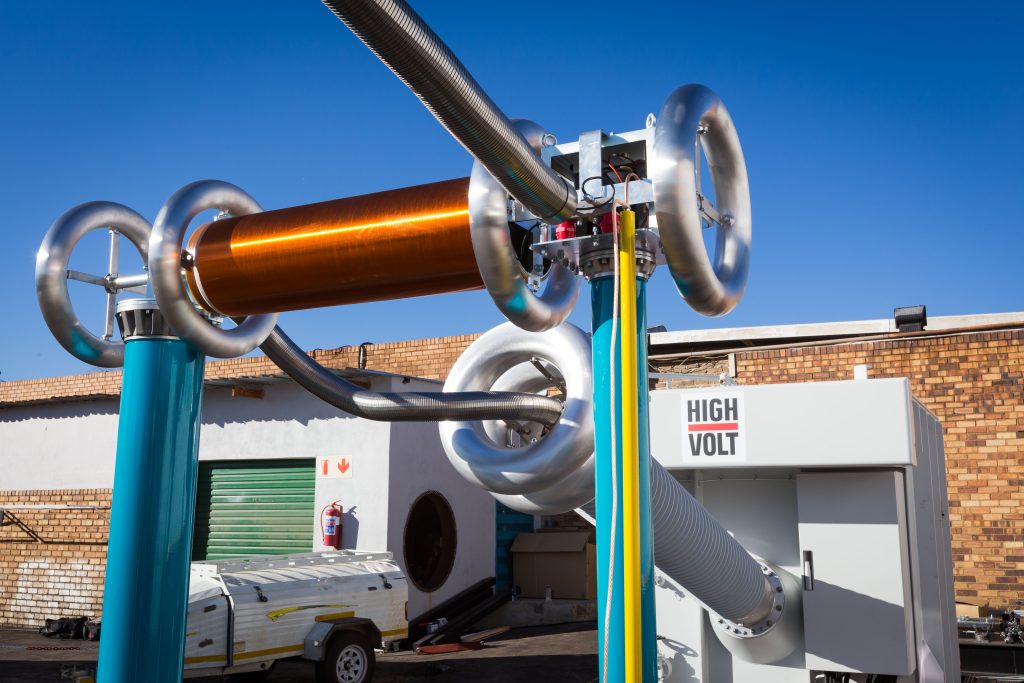
- Resonant Test (also known as near-power frequency test): A resonant circuit is created using reactors and the test object (capacitor). By tuning the frequency to the resonant point, a sinusoidal AC voltage between 20 and 300 Hz is applied.
International standards and working groups, such as CIGRE, do not recommend DAC testing. The peak voltage applied to the cable is higher than with other test methods, and the absence of a continuous voltage during testing limits its ability to perform a proper withstand test. We’ve encountered several cases where partial discharge began only after 10 minutes or more testing time – defects that DAC would fail to detect.
VLF testing, today facilitating a real sinusoidal waveform, is widely used for the medium voltage sector and we recommend VLF for grid voltages up to 30kV. You can explore more on this in our [Products>MV Cable & Oil testing] and [Solutions>Cables>Condition Assessment] sections.
Commission Tests
For your HV, MV, pilot, and telephone cables, we offer comprehensive pre-commissioning and commissioning tests, including:
- Phase-out
- Sheath testing
- Impedance and DC resistance measurement
- Cross-bonding test
- Varistor and contact resistance measurement
- And more
Combined with our high-voltage testing capabilities, these services provide a comprehensive solution from engineering preparation and commissioning through to final test reporting.
Partial Discharge Measurement
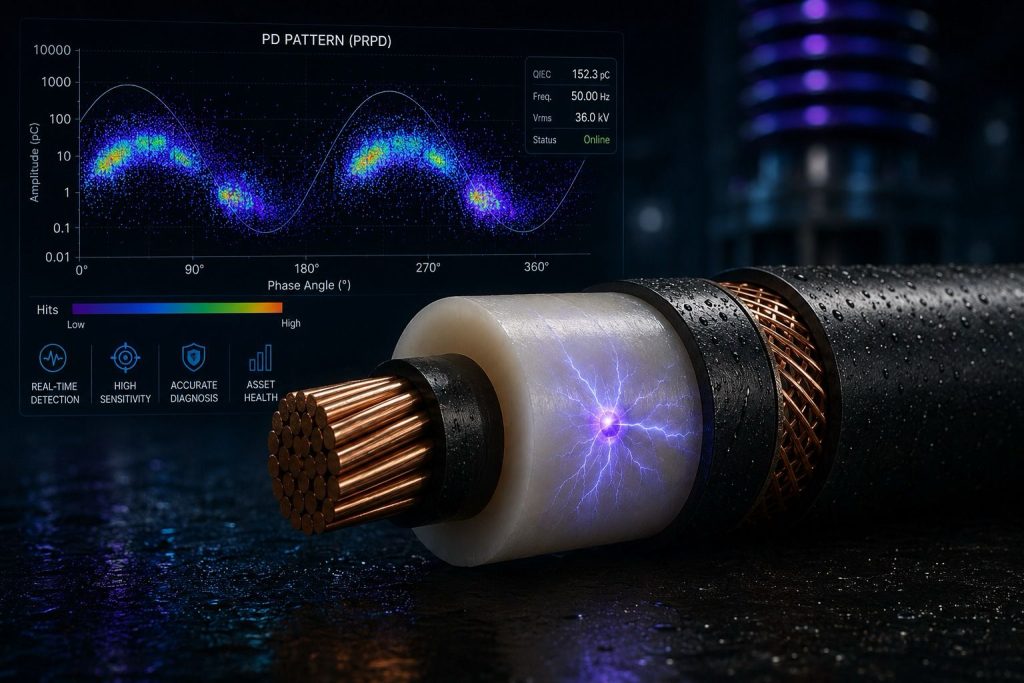
Partial discharge (PD) measurement is a valuable diagnostic technique used to detect localised electrical discharges within insulation systems that may develop into insulation failure if left undetected. It provides important insight into the condition of cables, transformers, gas-insulated switchgear and other high-voltage assets during commissioning, maintenance and diagnostic investigations.
PD measurements are typically performed at a reduced voltage level compared with the preceding withstand test. The acceptance criterion for HV applications is generally the absence of detectable partial discharge at the specified measurement voltage.
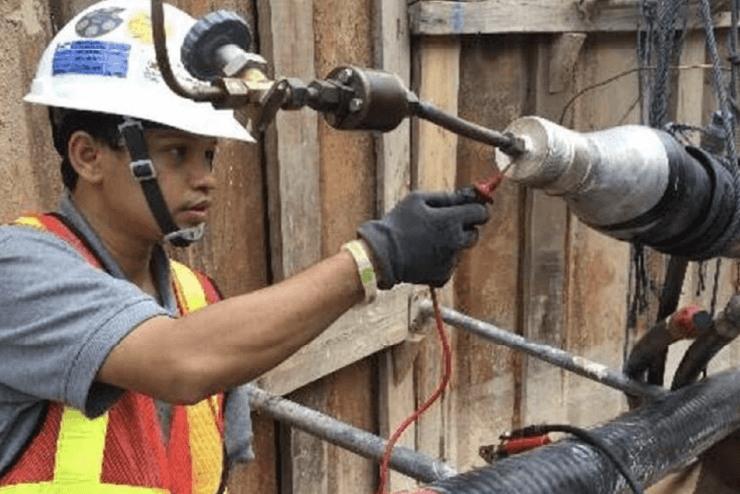
We provide PD measurement services using coupling capacitors, high-frequency current transformers (HFCTs) and ultrasonic detection technologies, supported by expert interpretation and analysis as part of selected high-voltage testing programmes.
Test with Experts. Perform with Confidence.
The High Voltage test is one of the final and in case of cables or gas insulated switch gears one of the most important commissioning test, as these assets are to a remarkable extent manufactured in the field rather than in the company. But also for transformers it is a quality assurance test at site to check the quality of factory production, transport and workmanship after final installation is completed.
Ensure your valuable HV asset is in optimal condition before final acceptance:
- Ensure correct installation: E.g. for HV cables CIGRE Brochure B1-210 concluded that in 8.3% of all tests a fault is identified!
- Realistic Test: Only a near power frequency test triggers partial discharge with a sufficient high probability.
- Ensure Asset Performance: Your assets need to withstand loads higher than the rated values, prove it with an HV test.
- Identify Latent Defects: Even no breakdown occurs, a partial discharge measurement uncovers inherent faults like voids or other imperfections.
- Avoid Consequential Damage: In case of a fault during test, the limited test power avoids collateral damage.
hvac
We provide specialised on-site HVAC testing services for critical high-voltage infrastructure.
We perform on-site High Voltage Resonant Test for
- HVAC cables up to 500kV
- Power Transformers up to 500kV
- Gas Insulated Switchgears up to 680kV
Our experienced specialists have successfully completed more than 190 on-site high-voltage resonant tests. Our specialists and test systems have supported high-voltage projects across multiple regions and operating environments worldwide.
hvDc
We provide specialised on-site HVDC testing services for high-voltage cable systems and associated infrastructure.
With our 800 kV HVDC test system, we perform on-site high-voltage DC tests for:
- HVDC cables up to 525kV
- HVDC Gas Insulated Switchgears
Our experienced specialists have successfully completed more than 190 on-site high-voltage tests.